| Item | Category | Cost | Sell | Effect | |
|---|---|---|---|---|---|
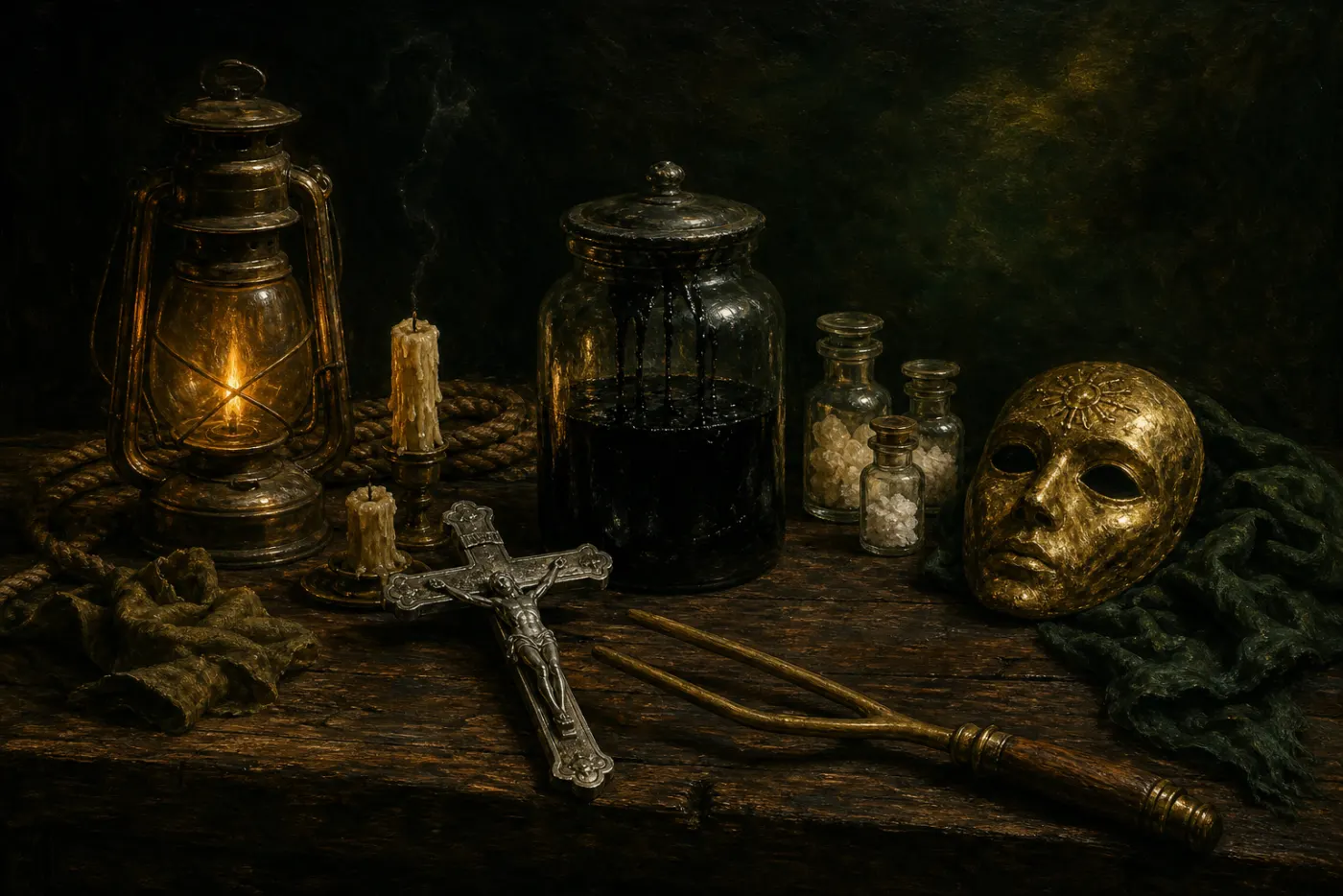
| Ammonia Salts | Support | 20c | 40–60c | Salt of hartshorn, and the only way to bring a downed crewmate back on their feet. Act fast: leave a body too long and the forest takes it, then sends it back as a Y'm-bhi. Three per pack, and every one of them is worth more than the coin. | |
| Crucifix | Support | 10c | 1–2c | Held up against something that has been turned, it makes the creature hesitate — hostility is slower to surface, and the moment its restraint breaks is easier for the whole crew to read. A pause button, not a weapon. | |
| Mask of Nyarlathotep | Support | 60c | 1–2c | Wear it and you read to others as an explorer who has already turned. The most expensive ordinary gear in the shop — only the story-critical Tulu cylinder is listed higher — and the only item that hides you rather than helping you fight. | |
| Bandage | Support | 3c | 16–24c | Stops a wound bleeding. Three coin each, stacks to ten, and sells back for 16–24 — five to eight times what it costs, which tells you how badly the appraiser thinks you'll need one. | |
| Food ration | Support | — | 40–60c | Restores health. Field-found rather than bought, and worth real coin if you can stand to carry it home instead of eating it. | |
| Censer | Support | 5c | — | A hanging incense burner. Listed by only one of our two sources, so we flag it rather than publish numbers we can't corroborate. | |
| Divining Rod of Yig | Tool | 40c | 1–2c | Vibrates near buried treasure; aim it and follow the glowing crystals to the dig spot. The only way to find buried caches, and dig spots move between runs — so it stays useful forever. | |
| Medallion | Tool | 15c | 1–2c | Magnetically drawn to Tulu metal, which is what idols and cylinders are made of. Fifteen coin to stop walking past the expensive things. | |
| Slave Finder | Tool | 30c | 1–2c | A K'n-yani sound bowl built to locate humanoids. Strike it and any human or human-like presence lights up — survivors to rescue, and the things wearing their shape. | |
| Jar of Black Ichor | Tool | 10c | 1–2c | Enrages and attracts most supernatural creatures. Throw it away from the crew to buy an exit, or at something you want another creature to deal with. | |
| Map | Tool | 30c | 1–2c | A rough chart pulled from a failed expedition's logbook — deliberately incomplete, because filling in the blanks is the job. | |
| Oil Lamp | Light | 5c | 16–24c | Wick and oil, steady and reliable. Five coin to buy and 16–24 back, three to five times over. Only the 3c Bandage returns a better multiple. | |
| Cthulhu Lantern | Light | 5c | 16–24c | Identical to the Oil Lamp in price and value; the difference is engraving. A Deluxe cosmetic that costs nothing extra in-run. | |
| Torch | Light | 5c | 1–5c | Disposable, and it can be dropped on the ground — which makes it a breadcrumb trail as much as a light. Worth almost nothing at the appraiser; burn it, don't bank it. | |
| Rushlight | Light | 5c | — | A rush dipped in fat — the poorest light a 16th-century expedition would carry. Listed by only one of our two sources. | |
| Breastplate | Armor | 30c | 1–3c | Forty defense for thirty coin — twice the helmet's protection for twice the price, and the single largest survivability purchase in the shop. It sells for almost nothing, so it's worn, not traded. | |
| Helmet | Armor | 15c | 1–3c | Twenty defense for fifteen coin. The cheap half of a full kit, and the piece most crews buy first. | |
| Broken Breastplate | Armor | — | 1–3c | Scrap metal. Zero defense — armour that has already done its job once. Found, never sold to you. | |
| Broken Helmet | Armor | — | 1–3c | Scrap metal, zero defense. Worth the same 1–3 coin as the intact version, which is the game telling you armour is for wearing. | |
| Gunpowder charge | Ammo | 1c | 1–3c | One shot for any firearm. Buy them singly at a coin each and stack ten — the cheapest way to fill a powder pouch. | |
| Charges case | Ammo | 10c | 1–2c | A box of many charges for ten coin. Convenient, but it occupies a whole inventory slot as a single item — ten loose charges in one slot is the better deal unless you're topping up mid-run. | |
| Bandolier | Ammo | 5c | 1–2c | A belt of a few charges for five coin. Sits between the single charge and the full case. | |
| Arrow | Ammo | 1c | 1–4c | One coin each, stacks to ten. Arrows are recoverable from what you shoot, which makes bows the cheapest sustained damage in the game. | |
| Arrows | Ammo | 5c | 1–2c | A bundle for five coin that takes one slot and doesn't stack — worse value than five singles unless slots are tight. | |
| Bolt | Ammo | 1c | 1–4c | Crossbow ammunition, a coin each, stacks to ten. | |
| Bolts | Ammo | 5c | 1–2c | A bundle of bolts. Same trade-off as the arrow bundle: convenience against stack efficiency. | |
| Firewood | Field | found | 8–12c | Gathered, not bought — chop it with a machete (the axe can't). Feeds camp fires, and it's worth more at the appraiser than a torch is. | |
| Huemul | Field | found | 40–60c | A deer. Kill it and haul the carcass to the ox-wagon; once the Cook survivor is aboard it upgrades the galleon. Butchered it also yields meat and hide, both worth more than the whole animal. | |
| Tulu metal cylinder | Field | 25,000c | 1–3c | Gold and black, marked with symbols of an ancient culture — the key objects the Story line is built around. The shop lists it at 25,000 coin, which is not a price so much as a joke about what it's worth to you. | |
Packing the six slots
A proven solo template from the demo: one gun, a machete, powder, food, and two slots left free for treasure. In a crew, specialize — one carrier of Ammonia Salts (the field revive), one light-bearer, one with the Slave Finder if the run involves rescuing survivors. The occult tools split by intent: the Divining Rod of Yig finds buried treasure, the Medallion pings Tulu metal, and the Jar of Black Ichor is a bait jar for turning an ambush around. The Mask of Nyarlathotep is the expensive trick — 60 coins to walk among the transformed unrecognized.
Firewood is gathered, not bought — chop it with the 5c machete, which the axe can't do. Gear issued by contracts expires after one expedition. And light is not optional: darkness drains sanity, while the Luz del Sur mushroom is the one forageable that pushes back on isolation.
The margins nobody mentions
Three prices in the table are worth staring at. A Bandage costs 3 coin and sells for 16–24 — the best return on any purchase in the shop, if you can finish a run without bleeding. An Oil Lamp costs 5 and sells for 16–24, same trick. And armour is the opposite: a Breastplate is 30 coin and sells for 1–3, which is the game telling you plainly that it is meant to be worn until it breaks, not flipped.
Ammunition has a slot trap. A single Gunpowder charge is 1 coin and stacks to ten; a Charges case is 10 coin and stacks to one. How many charges a case actually holds isn't published anywhere we can verify, so we won't claim the two are equivalent — but ten loose charges cost the same as one case and occupy the same single slot, which is the comparison worth making at the counter. Arrows and bolts run the same shape at a lower price point: 1c loose stacking to ten, 5c for a bundle that doesn't stack.
Armour
Two pieces, and between them the biggest survivability purchase available. A full kit is 45 coin for 60 defense — less than a Flintlock Musket, and it works in every weather. Broken versions are scrap: identical resale, zero protection.
Breastplate
Forty defense for thirty coin — twice the helmet's protection for twice the price, and the single largest survivability purchase in the shop. It sells for almost nothing, so it's worn, not traded.
Helmet
Twenty defense for fifteen coin. The cheap half of a full kit, and the piece most crews buy first.
Broken Breastplate
Scrap metal. Zero defense — armour that has already done its job once. Found, never sold to you.
Broken Helmet
Scrap metal, zero defense. Worth the same 1–3 coin as the intact version, which is the game telling you armour is for wearing.
Foraging the jungle
Thirteen things you can pick up and eat or sell. Most give a minor health boost and almost no coin — with two exceptions that change how you plan a run.
| Forageable | Sell | Stack | Effect |
|---|---|---|---|
| Luz del Sur Mushroom | 1–7c | 5 | Eating it reduces your feeling of isolation — the only foraged counter to the isolation driver in the sanity system, and the single most useful thing growing in the jungle. Learn what it looks like. |
| Huemul Meat | 80–120c | 1 | Butchered from a deer. At 80–120 coin a slot of meat is worth exactly what a Basic idol is — and the deer was standing on your route, where the idol needs a shrine detour. |
| Matico Flowers | 1–5c | 5 | Minor health boost. A real Andean medicinal plant, which is the sort of detail ACE Team keeps putting in. |
| Maqui Fruit | 1–5c | 10 | Minor health boost, and it stacks to ten — the most slot-efficient food in the jungle. |
| Pine Nut Fruit | 1–5c | 5 | The araucaria's fruit — the monkey-puzzle pine that defines the real Valdivian forest this map is modelled on. |
| Mushroom | 1–5c | 10 | The common mushroom, stacking to ten. Minor health boost. |
| Big Mushroom | 1–5c | 5 | Minor health boost. |
| Oyster Mushroom | 1–5c | 5 | Minor health boost. |
| Changle Mushroom | 1–5c | 5 | Minor health boost. Named for the real Chilean changle, a coral fungus. |
| Dihuene Mushroom | 1–5c | 5 | Minor health boost. Dihueñes are the real parasitic fungus that grows on southern beech. |
| Milcao del Monte Mushroom | 1–5c | 5 | Minor health boost. |
| Frog | 2–12c | 5 | A humble catch for the ship's larder. Stacks to five and the value range is unusually wide. |
| Dead Bandurria | 24–36c | 5 | A black-faced ibis brought down for rations. At 24–36 coin and stacking to five, a full stack is 120–180 in one slot — better than a Basic idol, short of an Advanced one. |
The two that matter: Luz del Sur is the only forageable that touches sanity, and huemul meat at 80–120 coin matches a Basic idol exactly, in a slot you filled without a shrine detour — see the treasure values.
Where to next
What to buy first and what to leave on the ship.
The other half of your loadout, with prices and rank locks.
Which items actually push back on the madness.
What you can afford depends on what the contract pays.
What you're carrying these against.
Field use — the small habits that save runs.
Item questions
How do you revive teammates in The Mound?
Two ways: use Ammonia Salts (20c) on the spot, or carry the body back to the ox-wagon and let the priest handle the resurrection. Revive fast — fallen explorers can return as hostile Y'm-bhi.
What does the Crucifix do in The Mound?
Held up at something that has been turned, it makes the creature hesitate — its hostility is slower to surface, and the moment restraint breaks is easier for everyone nearby to read. At 10 coin it is the cheapest panic button in the game, but it buys time rather than dealing damage.
How do you restore sanity in The Mound?
Eat the Luz del Sur mushroom — it is the one forageable whose described effect is reducing your feeling of isolation. Beyond that: stay near the ox-wagon (it slows sanity drain), regroup with your crew, and Saint Dymphna's blessing dispels madness effects outright.